As a hotel, we have a fixed inventory to sell. How do we make sure we sell it to the segments that will bring the most revenue? We do it through capacity control.
Not just increasing rates
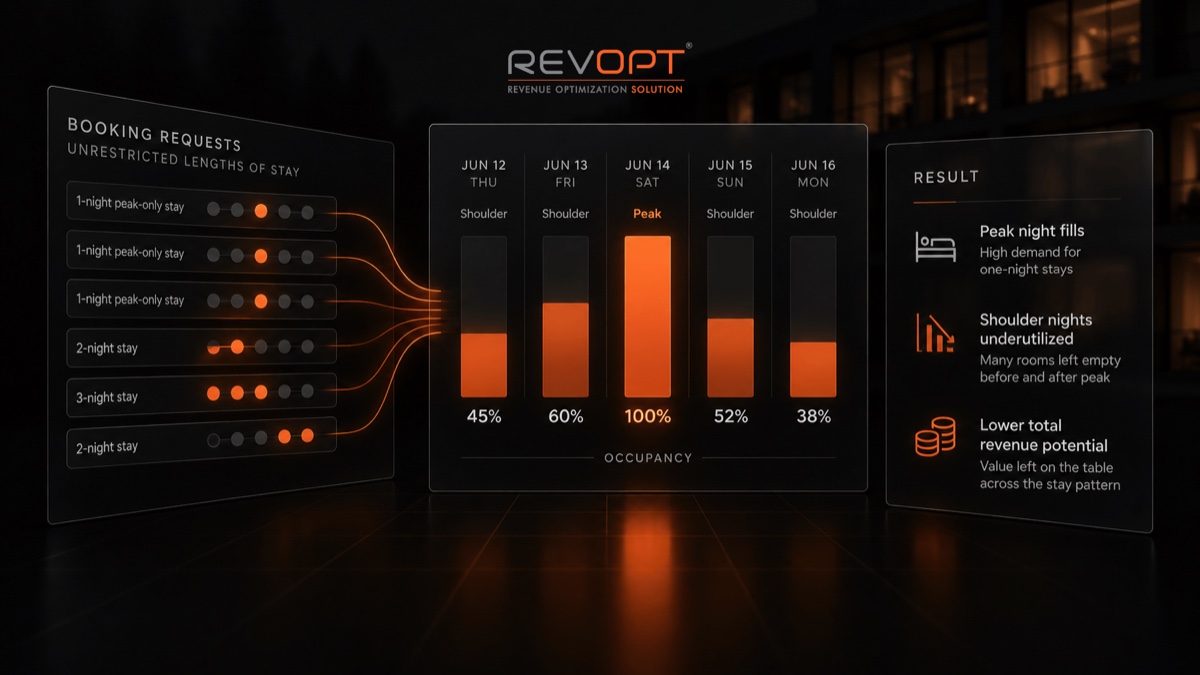
Revenue management is not about charging the highest rate. Over peak periods, for example, hotels can earn far more revenue and profit by increasing their guests' average length of stay than by increasing their rates.
Consider a hotel whose rate is $225 per night. Suppose it is frequently sold out on Tuesday and Wednesday nights, but has empty rooms on Monday and Thursday nights.
The hotel might raise its rate to $285 and still sell out on Tuesday and Wednesday. But it earns more if it can accept one more guest who arrives on Tuesday and stays through Thursday night at $225 per night.
The guest in the first scenario stays two nights and pays $570. The guest who stays through Thursday fills an empty room that night and pays $675.
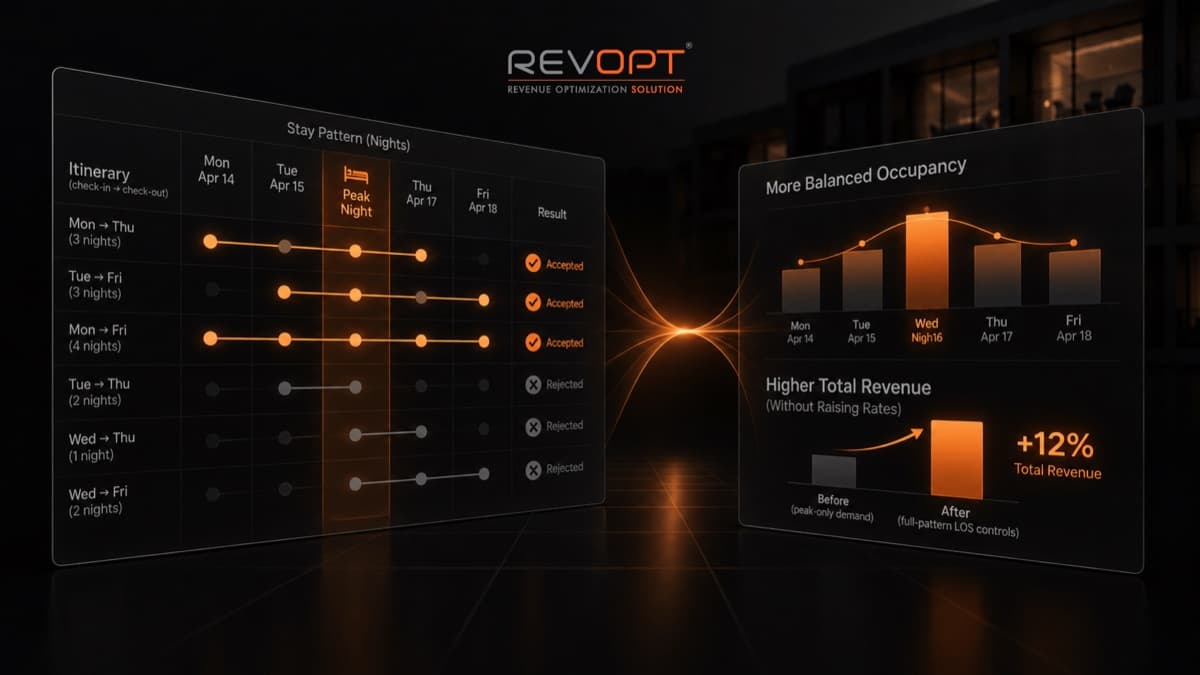
Length-of-stay controls, combined with precise overbooking, can significantly increase occupancy on the shoulder dates around a peak, along with overall room nights, revenue and profitability.
FPLOS controls
One way to control capacity is through length-of-stay (LOS) controls. They determine which lengths of stay will produce the most revenue for the hotel, and limit bookings to guests staying exactly those numbers of nights.
Full-pattern length-of-stay (FPLOS) controls add revenue on top of rate management alone, at no extra cost to the hotel. FPLOS controls can be translated into min-max and closed-to-arrival (CTA) control structures.
FPLOS controls let a hotel accept a discount rate for one- and two-night stays up to a peak period, close that rate for short stays over the peak, and then open it again for longer stays. This improves occupancy on the shoulder days and increases overall revenue.
Hotels also incur costs in a way that makes a multiple-night reservation more profitable than single-night reservations at the same rate.
The result is higher revenue and profit, from matching the forecast of future bookings against the available supply of rooms using FPLOS.
Benefits
- The hotel can accept the best business mix, increasing RevPAR.
- Occupancy on shoulder nights rises significantly, increasing overall revenue.
- Average length of stay over peak nights increases noticeably.
Implementation
When minimum and maximum length-of-stay controls are in place, guests who try to book stays that are too short or too long may be told there is no availability.
It is important to understand that "no availability" does not mean you have no rooms. Your property management system might show 10 rooms still available on a Wednesday night, but because you have a two-night minimum stay on that Wednesday, a search for one night will show no availability. The room stays reserved for a customer who wants to stay longer.
Guests should not be told that length-of-stay controls are in place, because they may book for longer than they intend to stay and then cancel the extra nights.
The right LOS controls have to be chosen across multiple prices in multiple segments, daily rate changes, changing inventory and a long booking horizon. As you can imagine, it is difficult for any revenue manager to manage this by hand every day. That is why this work has to be automated.
Length-of-stay controls benefit a hotel in several ways. They let it accept the most profitable business mix, which increases RevPAR. They significantly increase occupancy on shoulder nights, for an overall increase in revenue, and they noticeably lengthen the average stay over peak nights. At this level of detail, that is only possible with automation.