The key to profitability begins with the right pricing. While revenue management is the holy grail, having the right pricing strategy can be an effective means to optimise your business. However, as with most things, the strategy comes before the tactics. So before we look at how to actually set prices, it is important to understand the pricing structure.
What is a pricing structure?
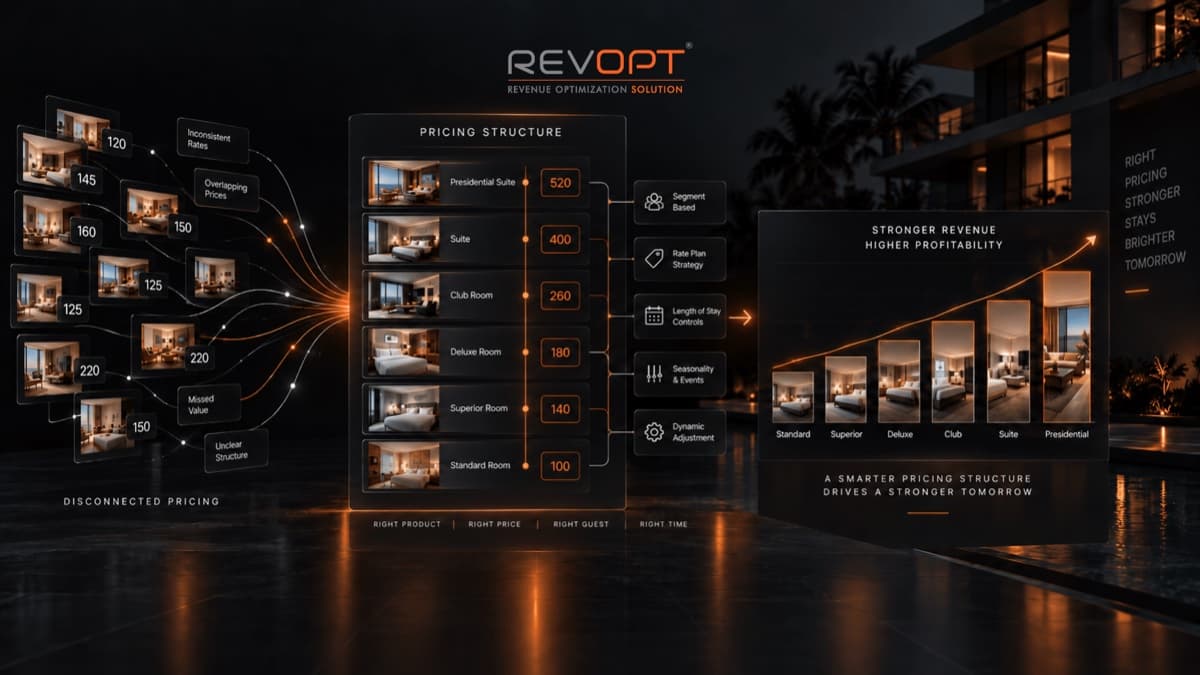
A pricing structure, also called a rate structure, is made up of all the rates you could potentially offer a customer. It varies for every hotel, based on the market segments the hotel serves. Pricing at the transaction level is managed in most hotels using a pricing structure.
Approach
Market segmentation
The right pricing structure takes many factors into account, but its foundation is market segmentation. Once you understand your business mix and your product positioning, you can set the pricing strategy for each market segment. It is important not only to evaluate past performance for each segment, but also to identify new segments and decide which segments you want to promote and which to discourage.
Sometimes a hotel is too dependent on one market segment, and that dependence can hurt its profitability. It is always a good idea to build a healthy business mix, which also lets you hedge your risks. Once you have defined the market segmentation for your hotel, your pricing structure will often mirror it.
Deciding on the price hierarchy
The next step is to decide which pricing mechanism (sometimes referred to as a rate plan) works best for which segments. You will need to define pricing for your transient and group segments.
Transient segment
For the transient segment, you need to decide whether to apply fixed rates, dynamic pricing or both. You will also need to keep in mind the concept of qualified and unqualified pricing.
Qualified: rates a customer can obtain by qualifying for certain criteria, such as volume within a specific period, lead time, length of stay, non-refundable terms or a full deposit. For example, "Book 7 days in advance for 15% off the Best Available Rate", commonly called an early-bird offer, is a qualified rate. A corporate rate negotiated for a specific period in return for volume is another example.
Unqualified: rates widely referred to as the Best Available Rate, Best Flexible Rate or Best Guaranteed Rate. They have no rate fencing and are unconditional.
Fixed rates: as the name implies, rates that are generally not altered except under certain conditions. They are often known as negotiated or contracted rates, and may apply for a set time frame and a specific volume of business. They may also be limited to a certain group of guests.
Dynamic rates: allow you to offer different prices based on the search criteria, length of stay, day of arrival and so on, driven by pricing transparency. Dynamic pricing gives you multiple price points, so you can adjust your prices to market volatility (cost, supply, demand and competition) and maximise your profits. It also means every customer is offered the same price at any given time. Read more about why dynamic pricing matters for hotels.
Best Available Rate (BAR): the optimal rate to quote, based on the probability of booking the guest. While effective, BAR requires the correct balance between demand and price. BAR is the recommended rate for customers who have no pre-contracted rate and do not qualify for any discount.
Group segments
Group rates: negotiated or contracted rates offered to customers who stay in groups, for business, leisure or social events, in return for a volume guarantee and usually for a specific period.
Group rates are often bundled with packages, conference facilities and so on, and are generally based on a detailed understanding of the customer's overall requirements. It is important to protect a certain level of room yield from group rates and to build layers of packages and attributes, so that even group rates reflect the cost and benefit of everything bundled with the room.
Other factors that affect group rates include whether the business is ad hoc or a series, and whether a venue or meeting space is involved along with the rooms. A carefully considered price structure, layered for these combinations, gives sales teams a clear structure to quote from and win business. These group rates are then used to calculate the displacement cost of the business for any given period before a rate is confirmed to the group.
Digging deeper
Fixed rates and dynamic pricing each have their merits, and each demands a closer look. Most hotels need a pricing structure that can handle both. Tie your pricing back to your segmentation: do they match, and is everything accounted for? One does not exclude the other; a mix of pricing models is the best option for most hotels and situations.
Fixed rates: the panacea for guaranteed business?
When considering fixed rates, what seems at first an obvious case for a fixed-rate contract is sometimes not so sensible beneath the surface.
For instance, companies are often offered negotiated corporate rates based on their volume of business (a Company Volume Guaranteed Rate, or CVGR). For the coming year, you may offer a better rate to Company A, which gave you more volume, than to Company B, which used fewer rooms in the same period. But what if Company A's volume came on your peak days, and the rest of the year its production was fairly small? And what if Company B's production was low but consistent all year? Would you still give Company A the better rate?
It may also be that Company A only comes on your peak days because it already has a competitor hotel lined up, and comes to you only when it cannot get rooms there. If it only uses you on peak days, when you could have sold those rooms at a higher rate to other customers, the true value of Company A to your business needs to be re-evaluated.
Dynamic pricing: as simple as it seems?
Customers increasingly accept dynamic pricing. The airline industry has conditioned travellers to see it as a fair approach.
While dynamic pricing seems a good choice, it needs structured processes and standards, consistency, and a thorough understanding of the whys and the whos to be effective.
The BAR levels themselves have to be defined carefully to get the benefit of this mechanism. And a single BAR may not capture all the value your market is willing to spend with you. That is why many hotels now use the Best Available Rate as the base for derivative BAR rates: rates linked to the BAR for that day, so any change to the BAR changes them too.
A discounted rate for booking 7 days in advance, set as a percentage off the BAR, is one example. This means you need to be extremely careful in how you select the base BAR for the day.
Putting it all together
Once you have carefully considered your market segmentation and your customers' value perceptions, bring all your pricing plans and rates together in a single, clear document. It should clearly separate the rate plans offered to each segment. Set the prices carefully so that one segment does not encroach on another. This document becomes the hotel's guide for every rate decision.
So what do we gain from all this?
Coupling your pricing structure closely to your market segmentation helps each segment keep developing. The price structure can be a strong tool to promote the segments that are more productive and higher-yielding for your hotel. Equally, you can apply a more restrictive pricing plan to low-yielding segments you want to wean away from. Over time this moves you towards the ideal business mix for your hotel.
Structured pricing lets you price each market segment independently, and stops one segment from eating into another.
The pricing structure also helps you plan and forecast the average rate for each micro-segment, and so arrive at the projected average daily rate for the hotel. That is a great help when you build your budget.
Overall, a structured approach to pricing helps you maximise the business from each segment, and gives your reservations and sales teams the clarity to go out and win business with confidence.